
Genocide .live

Palestinian men abducted and stripped by IDF in the Jabaliya area of northern Gaza
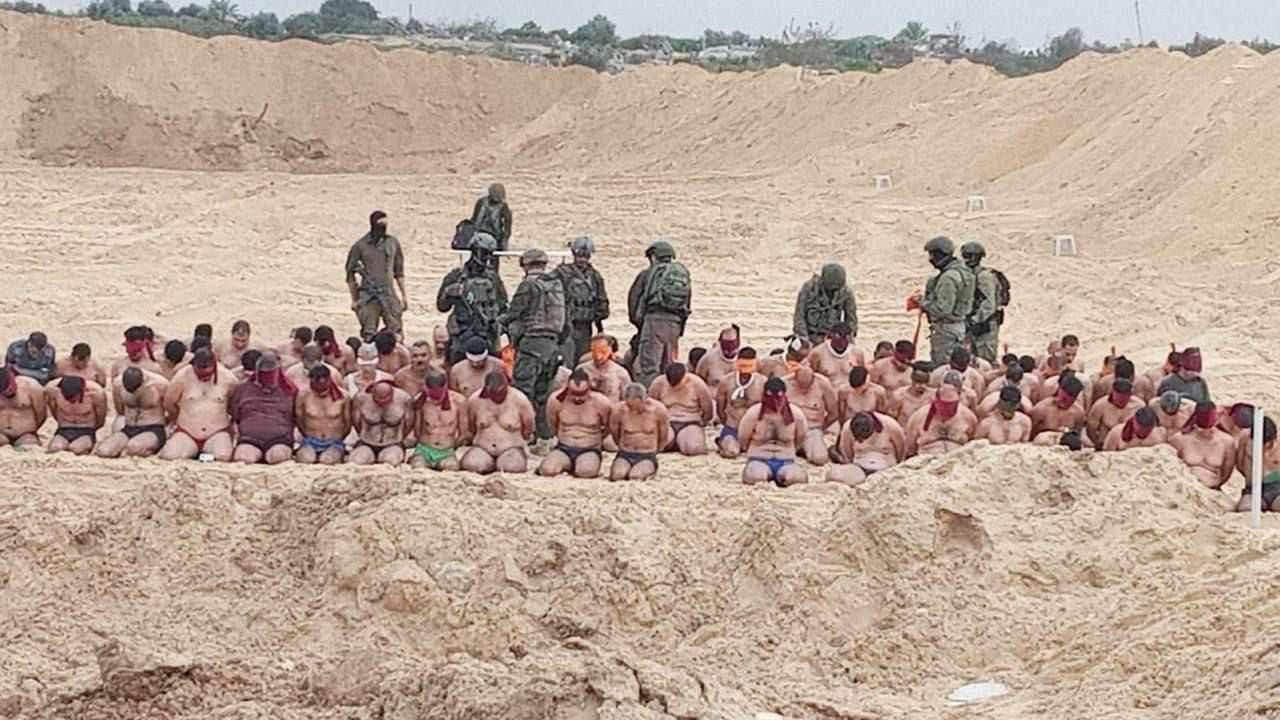
Original Social Media Post
"Photos show the Israeli occupation forces' arresting tens of Palestinian civilians, forcing them to strip off their clothes and subjecting them to abuse in the Beit Lahia in the northern Gaza Strip." - Source
Archivist Notes On This Video
An article of The Times of Israel treated this picture on December 18, 2023:
"7, 2023. (Social media: used in accordance with clause 27a of the copyright law) Palestinians who were among the hundreds arrested by the IDF in northern Gaza in scenes that went viral earlier this month said they were grossly mistreated by the soldiers.
Palestinians detained in the shattered town of Beit Lahiya, the urban refugee camp of Jabaliya and neighborhoods of Gaza City said they were bound, blindfolded and bundled into the backs of trucks. Some said they were taken to the camp at an undisclosed location, nearly naked and with little water.
“We were treated like cattle, they even wrote numbers on our hands,” said Ibrahim Lubbad, a 30-year-old computer engineer arrested in Beit Lahiya on December 7 with a dozen other family members and held overnight. “We could feel their hatred.”
“My only crime is not having enough money to flee to the south,” said Abu Adnan al-Kahlout, an unemployed 45-year-old with diabetes and high blood pressure in Beit Lahiya. He was detained on December 8 and released after several hours when soldiers saw he was too faint and nauseated to be interrogated.
“Do you think Hamas are the ones waiting in their homes for the Israelis to come find them now?” he asked. “We stayed because we have nothing to do with Hamas.”
“There are corpses all over the place, left out for three, four weeks because no one can reach them to bury them before the dogs eat them,” said Raji Sourani, a lawyer with the Palestinian Center for Human Rights in Gaza. He added that he saw dozens of dead bodies as he made his way from Gaza City to the southern border with Egypt last week.
Israeli forces are holding one of his colleagues, human rights researcher Ayman Lubbad, in custody.
Returning home brought its own hardship. Israeli soldiers dropped detainees off after midnight without their clothes, phones or IDs near what appeared to be Gaza’s northern border with Israel, those released said.
They added that they were ordered to walk through a landscape of destruction, tanks stationed along the road and snipers perched on roofs.
In response to questions about alleged mistreatment, the Israeli military says that detainees were “treated according to protocol” and were given enough food and water.
The army spokesman, Rear Adm. Daniel Hagari, said that arrests took place in two Hamas strongholds in northern Gaza and that detainees were told to strip to make sure they didn’t conceal explosives.
Hagari said the men are questioned and then told to dress, and that in cases where this didn’t happen, the military would ensure it doesn’t occur again.
Following the initial questioning, those believed to have ties to Hamas are taken away for further interrogation, and dozens of Hamas members have been arrested so far, he said.
The others are released and told to head south, where Israel has told people to seek refuge, Hagari says.
The IDF says those arrested included Hamas terrorists and that all detained were stopped for a reason.
Earlier this month, the IDF distributed photos of detained suspects in Gaza stripped down to their underwear, sparking concerns about arrest procedures and rights violations.
Both Hagari and National Security Adviser Tzachi Hanegbi criticized the publication of the photographs and vowed to ensure that they wouldn’t be circulated in the future.
Photographs published since have only depicted the suspects fully clothed."
Event Notes
Roundup of Palestinian men in northern GazaAround 7 December 2023, during Israeli military ground operations in northern Gaza, Israeli forces detained large groups (more than hundreds) of Palestinian men and boys in areas such as Beit Lahiya, Jabaliya, and Gaza City. Many were forced to strip to their underwear, blindfolded, and tied, and were filmed or photographed while sitting or kneeling in the street with their hands behind their heads.
Images and videos circulated widely online and in international media, showing dozens of detainees guarded by Israeli soldiers. Some detainees were also loaded onto military trucks and taken to detention sites for interrogation.
Witnesses and released detainees said the men were held for hours or days with minimal food or water, sometimes in cold conditions, while soldiers attempted to determine whether they were fighters or civilians.
Israeli authorities initially described the scene as the surrender of suspected militants, but relatives, journalists and human-rights organizations identified some of the detainees as civilians, including at least one journalist, Diaa Kahlout, reporter for Qatari media Al Arabi Al Jadeed. The news organisation said Kahlout had been rounded up along with his brothers, relatives and other civilians at the market street in Beit Lahiya, northern Gaza, and then “were forced to strip off their clothes and searched and humiliated before they were taken to an unknown location”. The Committee to Protect Journalists called for his release as Husam Zomlot, head of the Palestinian Mission in London, said on X the images evoked “some of humanity’s darkest passages of history”.
Several days later, around December 13, while Diaa Kahlout were not reappared, his home in Beit Lahia has been set on fire by Israeli forces, as his family revealed to The New Arab's Arabic. Israeli forces also burned down apartments belonging to two of his brothers in Gaza. He was finally released withut charge on January 9 2024, after 33 days of torture in Israeli detention camps, where he lost 44 pounds (20 kilos). He recounted his abduction and detention in an interview for El Pais.
Hani Almadhoun, who works at a US charity which raises funds for the UN’s Palestine relief agency, UNRWA, said he recognised his brother, Mahmoud, a shopkeeper, in one video: “I recognised him immediately … and recognised the area as the same area they had been sheltering.” His sister identified his 27-year-old nephew Abood packed in with a bunch of men in the back of a military truck. Almadhoun’s father and 13-year-old nephew, Omar, were also detained. All four were later released, said Hani, who added that none of them had links to militant groups.
Location of the footages:
Reports differ on where the initial images were filmed. An Israeli spokesperson said they were taken near Jabaliya and Shuja’iya, while Palestinians said they were from Beit Lahiya, claiming the men had been detained at two UN schools used as shelters.
In one widely shared photo, dozens of men in their underwear are seen kneeling, many blindfolded with their hands tied behind their backs, while Israeli soldiers stand over them.
One photo shows soldiers with assault rifles guarding dozens of men kneeling in a line alongside the wall of a building. Another photo shows detainees being lined up in an empty field.

The last video appears to show detainees packed into the back of moving army trucks.


Human-rights reporting:
Organizations such as Human Rights Watch reported that detainees in Gaza were sometimes stripped, photographed or filmed while semi-nude, calling such treatment degrading and potentially a violation of international law.
Around December 13, other pictures surfaces leakes by IDF soldiers, showing Israeli forces detaining hundreds of Palestinians in an open-air pit in northern Gaza, violating the Geneva Convention. The photo, posted on Channel 12 by security correspondent Nir Dvori, shows men in dark clothing inside a red-dirt berm, with some standing under a bright light and soldiers nearby.
The location, confirmed by X/Twitter user fdov21, is Beit Lahia, near Gaza University, at coordinates 31.541788, 34.505311. Satellite images match a white-roofed warehouse now partially destroyed. One detainee has been identified as Dr. Khalid Hamoda, a peaceful surgeon.