
Genocide .live

Project Crimson Thread is set to cut off vast lands from Palestinian access with the help of several terror outpost
Original Social Media Post
"🚨 Israeli settlers and army are escalating their attacks on the northern West Bank. Project Crimson Thread is set to cut off vast lands from Palestinian access, and several terror outposts were recently set up in the area, targeting Atouf, Yarza, Ras al-Ahmar, Tayasir and al-Aqaba." - Source
Tags
Event Notes
The Suffocation of Atouf: Crimson Thread and Hydrological StrangulationThe eastern area of Atouf, southeast of Tubas in the occupied West Bank has been subjected to continuous attacks by settler and escalating violations by Israeli forces. The area has also been targeted by several settlement-related projects, including the so-called Scarlet Thread project, or Crimson Thread Project, which involves constructing a military road and building a barrier through its lands.
They target the community, especially by stealing or cutting the water in order to make their living condition unbearable.
The physical displacement of Palestinian farmers in the Atouf plain (traditionally the "breadbasket" of the region) is not the result of isolated incidents, but rather a coordinated two-pronged pincer strategy combining state-led military infrastructure and local resource warfare:
a) The "Crimson Thread" project, a State-Led Infrastructure Weapon (Top-Down) promoted by the Israeli Ministry of Defense. His "Crimson Thread" project establishes a physical, high-tech barrier that cuts through privately owned Palestinian farmlands. By converting agricultural plains into military zones, the state permanently isolates Palestinian communities.
b) The Hydrological Strangulation Weapon (Bottom-Up to State-Supported): Paramilitary settlers perform daily, violent sabotage on water infrastructure (cutting lines, disabling pumping systems).This ground-level harassment is consolidated by the state via the military's administrative tools, such as issuing official demolition orders for wells, physical destruction of pipelines by army bulldozers, and military orders banning Palestinians from repairing damaged networks.
The Ultimate Objective: According to expert geographer Khalil Tafakji, because the military corridor does not align with typical settlement expansion plans, the destruction of the local agricultural economy is itself the primary military objective. By rendering farming impossible, the state seeks to break the geographic continuity of Palestinian land in the northern West Bank, preventing the viability of a future contiguous Palestinian state.
The "Crimson Thread" (Scarlet Thread) Project,
Guardian graphic. Source: Kerem Navot, B'Tselem
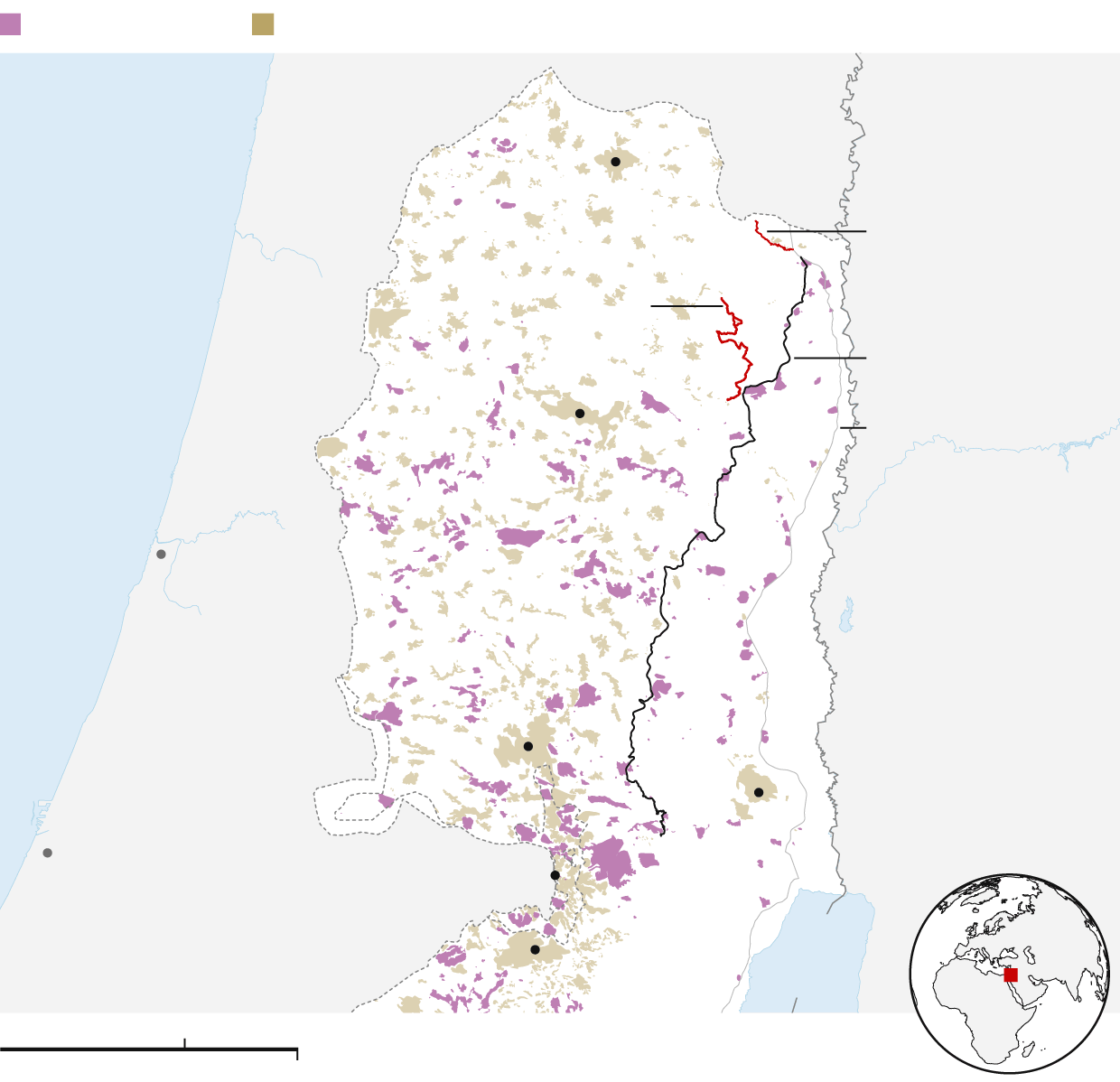
It costs a 5.5 billion-shekel (~£1.3bn) "smart" military barrier spanning 300 miles (500 km) along Israel's eastern border, from the Golan Heights to the Red Sea. It integrates a physical fence, radars, cameras, and intelligence sensors. The Atouf Segment: A 14-mile (22 km) strip running north-to-south through the plain.
Land Confiscation: Approximately 85% of the 1,000 dunams targeted in the initial eviction phase consists of highly fertile, privately-owned Palestinian land with official title deeds.
Exclusion Zones: The road and barrier itself span 50 meters in width, but are coupled with a 200-meter military exclusion cordon on either side where Palestinian building and farming are prohibited.
Hydrological Disruption: The corridor physically separates eastern agricultural fields from the hilltop water pipelines located to the west, permanently severing gravity-fed irrigation networks.
Enclavement: The tracé loops around and completely encloses communities like the herding village of Khirbet Yarza, cutting them off from Atouf with no guaranteed exit or entry.
Israel officially justified as a security measure following an August 2024 shooting on Route 90. However, human rights monitors and residents point out that Atouf has seen virtually no security incidents; the real motive is accelerated land seizure.
Chronology of the "Crimson Thread" projet
On August 2005, Under the original Disengagement Plan, Israel vacates its military presence and dismantles its settlements in the Gaza Strip alongside four settlements in the northern West Bank: Sanor, Kadim, Ganim, and Homesh, establishing a rare zone of contiguous Palestinian land.
On March 20, 2023, the Israeli Knesset passes an amendment to the 2005 Disengagement Law, legally lifting the ban on Israeli citizens entering and resettling the four evacuated northern West Bank settlement sites.
On May 29, 2023, to bypass legal challenges regarding private land ownership, settlers move the religious-military school (Yeshiva) at Homesh overnight to adjacent "state land," a relocation formally approved by Defense Minister Yoav Gallant. Subsequently, in August 2023, the Supreme Court annuls the Palestinian land lawsuit, and the army bars Palestinian landowners from accessing their surrounding fields.
On May 22, 2024, defense Minister Yoav Gallant signs a military order officially authorizing Israelis to return to and rebuild all four evacuated settlements in the northern West Bank.
On June 18, 2024, the Israeli Knesset officially passes a resolution rejecting the creation of an independent Palestinian state.
In August 2024, a 23-year-old Israeli is killed in a drive-by shooting along Route 90, and despite Atouf having virtually no historical security incidents, military planners cite this tragedy as the primary justification for creating an eastern military buffer zone.
Late January 2025, exactly seven days prior to the initial road demolition, Israeli forces impose a strict military curfew and carry out localized infrastructure damage in the Tammoun and Atouf area.
On December 4, 2025, overnight, the military tapes eviction and land confiscation notices onto homes, greenhouses, and wells along an almost 14-mile (22km) strip in Atouf, marking the official launch of the 5.5-billion-shekel "Crimson Thread" (Scarlet Thread) project, with farmers given 7 days to vacate.
On March 10, 2026, the military officially blocks all entrances and roads leading to eastern Atouf as part of the Scarlet Thread corridor's physical demarcation.
CHRONOLOGY OF the GROUND-LEVEL HYDROLOGICAL STRANGULATION
(The local war on water, daily settler harassment, well demolitions, and municipal blockades)
On February 4, 2025, the Israeli forces using a military bulldozer to carried a new attack including ravaging a section from agricultural road linking between Atouf village and Tamoun town with 80 length in addition to destroying water pipe line from Tamoun town towards Atouf village, noted that a water line with 8 inches diameter which was provided about 100 families from Atouf village with drinking water (1600 person).
On March 10, 2026, Israeli army closed the entrances and roads leading to the eastern area of the village of Atouf, and destroyed the water lines supplying the area. 30 families, totaling more than 180 residents, live in the area, which has now become completely besieged. Thousands of dunums of agricultural land have been left without water and are at risk of damage, while more than 12,000 sheep have also been left without access to water.
April–August 2026, for four consecutive months, settlers from surrounding outposts have been continuously damaging and cutting localized water lines supplying Atouf's crops, and although local Palestinian residents and municipal workers repeatedly attempted to repair the damaged lines, the Israeli military intervened on the ground, ordering the workers to leave and banning them from accessing the area.
On June 5, 2026, four Israeli settlers assaulted two Palestinian youths guarding an agricultural well in the Atouf area, before sabotaging the facility and attacking nearby families. They wore military‑style uniforms, assaulted the two youths duing the night while they were guarding the electricity room of an artesian well belonging to farmer Nazeer Mohammad Bisharat. Then they stormed the electricity room and tampered with the control panel, shutting down the well’s water pumping system. They also destroyed sections of the water line supplying homes and agricultural lands east of Atouf, disrupting access to water for both residents and farmland. The same group invaded the homes of five Palestinian families in the nearby Khirbet ar‑Ras al‑Ahmar community, assaulted residents, destroyed electrical networks, damaged surveillance cameras, and threatened to forcibly expel them within days.
Early August 2026, the Israeli army begins distributing formal administrative demolition orders for critical water wells across the Atouf plain, and has already demolished several of them.
In August, 2026, full-time farmer Durgham Muhammad, who manages 400 dunams of crops that sustain 30 farming families, is served an official demolition order for his private artesian well, and with his water supply compromised and the upcoming military road set to render his entire 400 dunams completely inaccessible, local agricultural production has practically ceased.